 Skip to content
Most Americans count on a tax refund, looking forward to a nice windfall that averaged $3,623 in 2026. If you’re asking yourself how to spend your tax refund, the more important question is how to spend your tax refund wisely. To make the most of your tax return, keep in mind that it’s not “free money.” It’s money you lent the government, interest free, over the course of the previous year and are now getting it back.
You can increase the value of your tax return by using at least some of it to reduce or pay off debt or decrease expenses, or putting it into savings or a tax-deductible account. The best ways to spend your tax refund are on things that will put more money back into your pocket and reap real financial rewards over the coming year, and even for years to come.
Should I Use My Tax Return to Pay off Debt?
Paying off or reducing debt is one of the best uses of tax return money. Eliminating revolving credit card debt with high interest will put more money back into your wallet than the interest you’d accumulate by putting the money into a savings account. Paying down debt also decreases your debt-to-income ratio, which will improve your credit score.
It’s important, though, to distinguish between “bad debt” and “good debt.” The most insidious debt is what builds up on a high-interest credit card. The average interest rate on a credit card is 22.3%, but if your cards are maxed out, you’re having trouble making payments, or even just making minimum payments, your rate is likely higher. Paying off or reducing what you owe will save a tremendous amount of money.
If you have “good debt,” like a mortgage, low-interest loan or credit card with a payment you can manage, then using your tax refund to pay it will have more limited benefits and it might make sense to use the money for savings or cutting some other expense.
If you’re going to use your tax return to pay off debt, aim it at the most effective target, where using the money will have the most impact.
Eliminate High-Interest Credit Card Debt
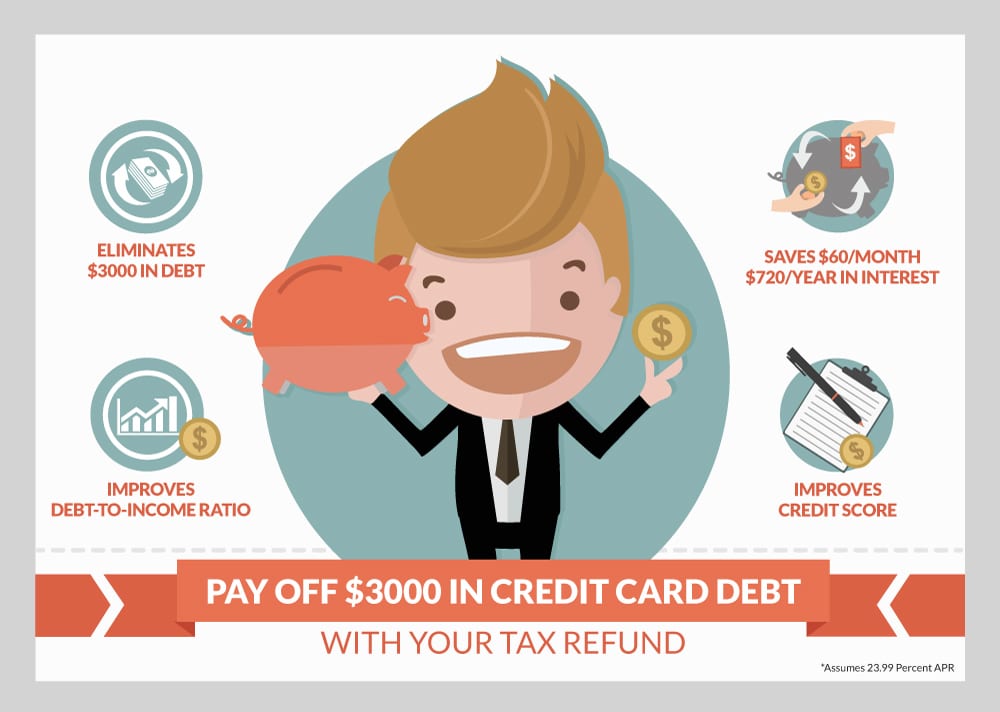
Your tax return can make a major dent in high-interest credit card debt, and if you can’t pay off the balance, what you do pay off will have long-lasting effects. Say you have a credit card balance of $3,000 and are paying the average interest rate of 22.3%. That means you pay about $56 a month in interest. If you’re just making minimum payments and not reducing the balance, that’s an extra $672 a year. But that’s not the full story. Take a look at your credit card statement – there’s a section that shows how long it’ll take you to pay it off and how much extra you’ll pay if you only make minimum payments. That card could take as long as 15 years to pay off, with around $4,000 in interest paid in addition to the original balance.
If you’re carrying balances on more than one credit card, and/or your interest rate, or rates, is higher, that just compounds the problem.
Avalanche and Snowball Debt Reduction
Consider targeting one or more cards with your tax return money. Two popular strategies are the “avalanche” and “snowball.”
With the avalanche method, you target the card with the highest interest rate, paying the minimum on your other cards. Once that big bill is paid off, use the money that was going toward that monthly payment to increase the payments on the second-highest interest card. Keep doing it until the cards are paid off.
With the snowball method, pay off the card with the smallest balance first. Then use the money that had been going toward that payment for the one with the next-smallest balance, etc.
Which method you use depends on the size of your tax return, how many cards you have, and what the balances are. Since a tax return is a one-time major chunk of money, the most financially effective method would be to pay off, or significantly reduce, the balance with the highest interest rate.
Use the 50/30/20 Tax Refund Rule
A tax return is, for many people, the only large windfall they get. The temptation is to use it for something fun or exciting, especially if you’re living paycheck-to-paycheck and have a tight budget. The 50/30/20 tax refund rule is a framework that makes sure a good portion of the money goes toward strengthening your financial situation, but also lets you splurge on some fun.
The way the 50/30/20 tax refund method works is:
- 50% goes to debt repayment, an emergency fund and/or a retirement fund.
- 30% goes to savings for a down payment, education, or major home or car repairs.
- 20% goes to a vacation, hobby or other fun purchase.
The specifics of each category are up to you and are based on your goals and priorities. That said, everyone should have an emergency fund as well as a separate reserve fund for things like home or auto repairs that you know are on the horizon.
Build or Replenish Your Emergency Savings Account
If you don’t have an emergency fund, or you drained yours the last time your car broke down, use your tax refund to begin building a new one, or replenishing the one you have.
An emergency fund should be able to cover 3-6 months worth of monthly expenses. If you’re not one of the 47% of Americans who say they can cover a $1,000 emergency with the money they have on hand, then building that fund is essential. Having an emergency fund will help you avoid using credit cards or turning to super high-interest payday loans or title loans if you’re hit with an emergency.
Save for Short-Term Goals and Irregular Expenses
If you have an emergency fund and your credit cards are under control, the best use of your tax return may be a savings account that can be used for upcoming expense, like a down payment on a car or security deposit on an apartment. Having that money put aside for budget busters that you know are coming will give you peace of mind, and it’ll also accumulate interest in the meantime. Will you owe a big property tax bill? Annual insurance payment? Or want to have money put aside for holiday shopping? Saving now will feel like a windfall when the time to use the money arrives.
Consider putting the money into a certificate of deposit (CD) or money market account, which have higher interest rates than savings. CDs have the added benefit of penalties for early withdrawal, so you won’t be tempted to take the money out early and use it for something else. If you have a big end-of-year bill, your tax return comes at the ideal time to put it in a 6-month CD. With a money market account, you can draw the money out as needed. Both are offered by traditional banks, credit unions, and online lenders.
Get Ahead on Auto Loans or Mortgage Principal
You can save money in the long run, or even immediately, but using your tax refund to pay off or get ahead of your auto loan, or pay down the principal on your mortgage.
If your tax refund covers what you owe on your vehicle, paying that off means no monthly car payment. That’s extra money every month to pay other bills, put in savings, or pay down credit cards. Even a partial payment on the principal will save you money, decreasing what you’ll pay in interest. If your lender uses the simple interest method, you can apply that amount directly to your principal, shortening your loan term and the amount of interest paid. (Simple interest means that the interest is calculated on what you borrowed and the length of the loan, and doesn’t compound).
If you have a mortgage, your tax return amount may seem like it won’t make much of a difference, but if you use it to directly pay principal, it can shorten your payoff time by several payments and reduce what you’ll pay in interest.
Boost Your Retirement Savings and Leverage Tax Advantages
If you are credit card debt-free and have adequate savings, consider using your tax refund to begin a retirement account, especially if you are not earning a pension or are contributing to an employer-sponsored 401(k) plan. Opening an IRA (Individual Retirement Account) at a bank or through a brokerage firm is an easy way to set aside money for retirement that can grow tax-free through your working years.
How much you can contribute to an IRA changes yearly, based on cost of living, and is set by the IRS. The contribution limit in 2026 was $7,500 for those age 50 or younger, and $8,600 if for those older than 50. Money you put in a traditional IRA is tax deductible if you don’t have a retirement plan through your employer and you meet certain income limits. [A tax deduction reduces the amount of income that you’re taxed on]. That means your tax refund money will be working for you in the short term, as well as long-term.
Fund an HSA or a 529 College Savings Plan
You can also have that tax refund money work double-time for you with other pre-tax investments, like a health savings account or a college savings fund.
Contributing to an HSA [Health Savings Account]
An HSA is a savings account that you use for medical and health care expenses. The money goes into the account before taxes are taken out. The account rolls over indefinitely, it doesn’t have to be used up by the end of the year. The 2026 limits for tax-free contributions were $4,400 for an individual and $8,750 for a family. The account comes with a debit card and can be used for most medical expenses, as well as prescriptions and even some over-the-counter medications. If you enroll in Medicare, you can no longer contribute to an HSA, or you may be penalized by the IRS, so keep that in mind if you’re retirement age or closing in on it.
529 College Savings Plans
A 529 College Savings account is specifically for education expenses, and can be a prepaid tuition plan or a more general savings plan. Plans are set up by states, so there are some differences state-to-state, but the structure is the same. Anyone can set one up, and anyone can be the beneficiary. Typically, a parent or grandparent sets one up for a child. Anyone who likes can contribute to the account. Contributions are not federal tax-deductible, but some states offer deductions or tax credits. The tax savings comes for the account owner or beneficiary, when the money is used for qualified education expenses (non-qualified use is taxed). Money can be withdrawn up to $20,000 for school tuition, kindergarten through college including apprenticeship programs, and up to $10,000 for student loan payments.
Invest in Your Career, Small Business, or Your Home
Another way to put your tax return to work is to use it for something that will save money on monthly expenses or help to increase your income.
If you’re making monthly payments on subscriptions for business use – Adobe or a website, for instance – it’s often cheaper to pay annually. Now is the time to transition and cut out those monthly payments. If you’re self-employed, or own a small business, investing in that piece of equipment that’s been just out of reach [a new, more powerful laptop, for instance] may help you on the job and is tax-deductible.
If you want to increase your income, consider using tax return money to pay for a professional certification course, or other education or training, that will improve your marketability.
You can also reduce costs of owning a home, especially if you live somewhere that gets really hot or really cold. Check out energy-efficient upgrades like a smart thermostat, better insulation, new windows, or a change to your heating or cooling system. Even small changes can decrease monthly expenses.
Balance Financial Stability with Responsible Splurging and Charity
It’s human nature, when your bank account suddenly expands, to want to spend some on something fun or indulge yourself. It’s also not a bad idea, psychologically. You can satisfy that need while also using your tax return responsibly by setting aside a percentage to indulge yourself.
Budget 10%, 20% or whatever makes sense, to treat yourself, and then use the rest to help build a stronger financial foundation.
It may also make you feel good to donate to a cause, especially if you’ve wanted to, but haven’t had the money in your budget. If there’s something you feel strongly about, or see a need in your community, now is your chance to help make a difference. It’ll make you feel just as good, or maybe better, than splurging on something for yourself.
If you want to make a contribution that’s tax-deductible, be sure it’s to a 501(c)(3) organization. As of 2026, people who don’t itemize their taxes, but take the standard deduction, can deduct $1,000 for charitable donations ($2,000 for married filing jointly). Most nonprofits will provide that information on their websites. Some other nonprofits, like churches and veterans groups, also qualify. Political organizations and campaigns do not.
Strategies Now to Prevent a Large Refund Next Year
As much fun as it is to get that big tax return, it is a “return.” It’s money that you overpaid to the government, and now they’re giving it back to you. That money could’ve been working for you during the time the government was holding onto it and not paying interest.
A tax return is generally considered too high – you’re overpaying the government too much – if it’s above the average, which was $3,623 in 2026.
Lower the amount that comes out of your pay, and put the extra money into a high-interest savings account, a retirement account, an emergency fund, or use it to pay down credit cards.
To reduce the amount of money you contribute through the year for federal taxes:
If you are employed in a job in which you get a W-2 tax form, or get a pension that withholds taxes, you can use the IRS Tax Withholding Estimator to determine how much should be withheld from your paycheck. If you’d like less federal tax taken out of your paycheck, you can update your W-4 form with your employer. This is especially important if you have a major life change that will affect your taxes, like getting married or having a child.
If you are self-employed you’re likely paying estimated quarterly taxes (or should be). The IRS has a webpage with guidance on how to estimate your taxes and other information self-employed taxpayer need to figure out what to pay. It may be worth your while to pay a certified public accountant or other tax professional to prepare your taxes. They can not only maximize your business deductions, but also offer tips on how much you should be contributing. A CPA’s fee will be based on how complex your taxes are, and other factors, and can be anywhere from $150 to $800 or more, but the tax savings they’ll find for you will likely exceed that.
Whether you have a W-2 job or are self-employed, use any savings from reducing your withholding in a way that will help your financial foundation. Don’t think of getting a smaller tax refund as a disappointment, but as a sign that you’re being more efficient with your own money. And when you do get a tax return, put it to work to build on your smart money decisions.
















Sources:
- N.A. (2026, March 20) Filing season statistics for week ending March 13, 2026. Retrieved from https://www.irs.gov/newsroom/filing-season-statistics-for-week-ending-march-13-2026
- Zhang, J. et al (2026, March 17) Interest Nation: The State of America’s Credit Card Debt Crisis. Retrieved from https://tcf.org/content/report/interest-nation-the-state-of-americas-credit-card-debt-crisis/
- N.A. (2026, March 6) Consumer Credit G-19. Retrieved from https://www.federalreserve.gov/releases/g19/current/
- N.A. (ND) Dealing with Debt. Retrieved from https://mycreditunion.gov/manage-your-money/dealing-debt
- Bennett, K. (2026, February 4) Bankrate’s 2026 Annual Emergency Savings Report. Retrieved from https://www.bankrate.com/banking/savings/emergency-savings-report/
- N.A. (ND) Retirement topics: IRA Contribution Limits. Retrieved from https://www.irs.gov/retirement-plans/plan-participant-employee/retirement-topics-ira-contribution-limits
- Choi, A.; Rosso, R. (2026, February 23) Health Savings Accounts (HSAs). Retrieved from https://www.congress.gov/crs-product/R45277
- N.A. (ND) 529 Plans: Questions and Answers. Retrieved from https://www.irs.gov/newsroom/529-plans-questions-and-answers
- N.A. (ND) Is my tax return to large? Retrieved from https://agcu.org/is-your-tax-refund-too-large