 Skip to content
Is Rent-to-Own a Good Idea?
 Robert ShawRobert Shaw
Author
After a 45-year career in journalism, Robert's focus is helping consumers cope with personal finance issues. Finding solutions to paying off credit card debt, mortgage payments and that darn student loan, is far more fulfilling than…
View author profileSee How Much You Could Save on Credit Card Payments
Complete a quick online assessment to see your potential savings on credit card payments through an InCharge Debt Management Program.




You don’t have to remember Tom Hanks and Shelley Long in the classic comedy “The Money Pit” to realize home ownership can be an expensive proposition.
In fact, in this inflated real estate market, the renovation project that reveals a legion of squatter termites living the good life in your attic, wouldn’t be the sticker shock challenging many prospective homeowners.
The latest statistics from the National Association of Realtors shows a national median single-family home price of $398,900. The standard down payment of 20% on that amount? A cool $79,600. Not many consumers have that kind of dough sitting in their bank account.
An FHA loan would be friendlier for sure, but even a 3.5% down payment means having a spare $13,930 to unlock the front door. That’s not an easy lift for many, especially first-time home buyers.
The high cost of home ownership and the high hurdle of mortgage qualification is why pursuing a rent-to-own agreement could be beneficial for those wanting a foot in the door of home ownership.
» Learn More: Pros & Cons of Buying a House
What Is Rent-to-Own?
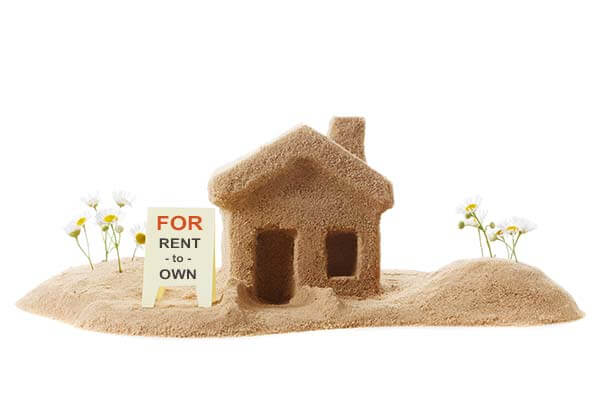
Rent-to-own is an agreement in which you rent a home for a specific period of time with the option to buy it. Typically, the agreement includes a non-refundable percentage of your monthly payments going toward a down payment when the lease expires.
If you want to own your own home and take advantage of all the benefits of home ownership, renting-to-own might be a reasonable entry into the market.
“I’ve done rent-to-own deals on behalf of buyers as well as sellers over the years,” said real estate agent Gregg Wasilko, a top earner at Howard Hanna in Ohio. “In this market, where sellers are getting their asking price and sometimes more than their asking price, and homes are selling quickly, rent-to-own sales are not as common.”
Wasilko said buyers looking at rent-to-own often do so for a variety of reasons:
- They’re new to their jobs.
- Lenders may want evidence of more permanent employment before extending them a mortgage.
- They lack the down payment necessary to qualify for a mortgage.
- They need time to rebuild their credit after debt settlement or bankruptcy.
“The terms of the agreement – how long and/or how much of their monthly rent goes to a down payment – is entirely negotiable between buyer and seller,” Wasilko said.
How Does Rent to Own Work?
Most rent-to-own agreements fall into two categories: lease option and lease purchase. They are exactly what they suggest.
A lease option gives you the option to buy the home at a later date but carries no legal obligation. A lease purchase is a commitment to buy at a mutually agreed upon time and could result in legal proceedings if you renege.
Deciding which option (if either) best fits your circumstances could depend on a number of factors. One basic tool can help clarify whether continuing to rent makes the most financial sense. It’s called the price-to-rent ratio.
The price-to-rent ratio requires some math homework but it’s not really complicated. Take the median single family home price in the area where you want to buy and divide it by your annual rent cost. If the number you come away with is less than 15, renting might be too expensive to justify.
For instance, If the median home price in your area is $300,000 and the median monthly rent is $18,000 a year ($1,500 a month), you’d be right on the bubble (16.6) where it could make more sense to buy than rent.
If the median rent is $1,000 a month and the median home price is $300,000, then the price-to-rent ratio goes up to 25 and renting (while saving for a down payment) would make more financial sense.
Rent-to-Own Pros and Cons
Rent-to-own homes can sound like a win-win: you get to live in the home now while working toward owning it later. For some people, that setup can feel like a stepping stone into homeownership. However, it’s important to understand that these arrangements come with risks and benefits.
On the plus side, rent-to-own can give you time to get your finances in order. If you need to build credit, save more cash, or stabilize your income, this kind of agreement may offer breathing room while you work toward buying. You may also get the chance to lock in a future purchase price and live in the home before fully committing, which can be appealing if you’re unsure about the neighborhood or the property itself.
But the downsides with rent-to-own can be significant.
Rent-to-own contracts are often more expensive than standard rentals, and the extra money you pay isn’t always guaranteed to help you in the long run. If you can’t qualify for a mortgage, you may lose option fees or rent credits entirely.
For most renters interested in homeownership, rent-to-own is not the ideal path. However, it can be beneficial in certain cases, if the terms are fair and you fully understand what you’re signing up for.
Rent-to-Own Benefits
Rent-to-own might work if qualifying for a mortgage isn’t likely, or if you simply need time to assess your financial situation or employment stability.
Prospective buyers in a rent-to-own agreement are often attracted to the idea of building equity in a home they might not otherwise be able to afford to purchase. It also gets you into the house you want to buy, saving the cost and hassle of another move while you save for a down payment.
Think of renting-to-own as gaining some breathing room before plunging into the housing market pool, breathing room in some cases made necessary to rebuild bad credit and qualify for a lower interest rate.
Other benefits of rent-to-own:
- Locking in a price while a portion of your rent goes toward the purchase takes some of the anxiety out of watching prices continue to go up in the area where you know you want to live.
- If you’re in a lease option agreement as opposed to a lease purchase agreement, renting-to-own allows you to take stock of the home, the neighborhood, etc. while you save for a down payment. Do you like the style of home as much as you thought you would? Is maintenance more of an issue than expected? (Is that an Iditarod full of sled dogs living two doors down? Who knew?)
- Rent-to-own allows potential buyers to build up rent credits toward the total price, which may make it easier to get a good rate on an eventual mortgage.
- Did we mention locking in the price? It’s worth repeating, especially if the home is in a neighborhood where the prices have steadily increased in previous years.
Rent-to-Own Disadvantages
Rent-to-own is not without its pitfalls and these should be studied carefully.
- Higher rent: In addition to you paying an upfront option fee anywhere from 1%-5%, the homeowner might insist on a monthly rental that is 10%-15% higher than the market average since a portion of the rental is going toward your down payment.
- Maintenance costs: Some agreements ask the potential homebuyer to pay for some maintenance costs, like those under $500, while the home owner agrees to pay maintenance costs above that line. That’s an important part of negotiation and can get expensive.
- Qualifying for a mortgage: In a rent-to-own agreement, you could lose what you’ve paid upfront and the monthly percentage toward a down payment if you can’t meet the terms of the agreement because you still don’t qualify for a mortgage at the end of the lease.
- Obligation to buy: You could lose more than money already paid if the agreement is a lease purchase instead of a lease option. Failure to meet the obligations outlined in a lease purchase could leave you facing costly legal proceedings.
- Unforeseen problems: What’s that Insurance slogan: “Life comes at you fast.” Some things could be out of your control, such as a change in your employment or the owner of the house defaulting on the mortgage or taking out a sizable home equity loan on the property before your rent-to-own period ends.
- Locked in Purchase Price: It’s an advantage if the housing market goes up during your rent-to-own period. It could be a disadvantage if the market stalls or goes down.
Does Rent-to-Own Affect Your Credit Score?
Rent-to-own agreements are not reported to credit bureaus so your credit score is unaffected. Unless … if your expressed hope is to use the rent-to-own agreement period to build your credit score through on-time payments, you can ask the homeowner to report your payments to the credit bureau.
The flip side of that? Late payments could get reported, too, defeating your purpose.
Tips for People Interested in Rent-to-Own
Rent-to-Own contracts should benefit the buyer and the seller alike. Both sides should carefully negotiate the deal specific to their respective needs and not apply a cookie-cutter agreement that leaves loopholes.
You should put all the diligence into a rent-to-own agreement that you would if you were buying a home outright. Even more in fact.
If you think rent-to-own is your best entry into the housing market, you should:
- Consult a real estate lawyer. This is their wheelhouse. If it’s not yours, it’s smart to let an expert read over the agreement.
- Get a home inspection. Especially if you’re assuming some of the maintenance costs during the rent-to-own period but also for longer-range peace of mind.
- Meet with your lender. You want to make sure you are in the on-deck circle for a mortgage at a rate that works for you by the end of the rent-to-own period.
- Ask for a seller’s disclosure. You should know as much as possible about the property, title, etc. both for the present and the future.
Rent-to-Own Alternatives
Renting-to-own may not be your best option for reasons we’ve discussed. You could end up forfeiting money you’ve earmarked for a down payment if you determine it’s not the right house for you.
In addition, sellers are more open to rent-to-own agreements if they are having trouble attracting buyers. Maybe there’s a reason for that?
In a hot real estate market, there’s likely not ample rent-to-own inventory in the area where you are looking to live. Sellers are getting their asking price, and homes are selling quickly.
So, if rent-to-own isn’t your most practical option for whatever reason, it’s good to know the alternatives:
- FHA loans: An FHA loan can allow you to buy a home under looser financial requirements. The mortgage qualification hurdle is significantly higher with private lenders than with a government-backed loan. Such a loan could be a good alternative because the required down payment is sometimes as low as 3.5% and because a buyer with a low credit score can more easily qualify for an FHA loan than a conventional loan.
- Traditional renting: You’re not building equity, true. But the image of your hard-earned dollars flying out an open apartment window isn’t quite accurate, especially if paying a more modest monthly rent allows you to save for a down payment while chipping away at your debt.
- Improving your credit score: Renting-to-own might work for you in certain circumstances. But rent-to-own agreements can also work against you.
Rent-to-own payments, as we mentioned, are not reported to a credit bureau unless your landlord agrees to report them at your request.
Fortunately, there are other avenues available to bolster poor credit and save for a down payment.
The best way? Making on-time payments on your existing debt – a challenge that can best be tackled through the budgeting help, debt management and expert advice available through credit counseling.
See How Much You Could Save on Credit Card Payments
Complete a quick online assessment to see your potential savings on credit card payments through an InCharge Debt Management Program.
Frequently Asked Questions
Rent-to-own can be a good idea in specific situations, such as when you need time to improve credit, save for a down payment, or stabilize your income before applying for a mortgage. However, it is not the best choice for most buyers unless the contract terms are fair and clearly understood.
Rent-to-own allows you to rent a home for a set period with the option, or sometimes the obligation, to buy it later. In many agreements, part of your monthly rent may be credited toward the future purchase, but those credits may be lost if you do not buy the home.
A lease option gives you the right to buy the home later, but you are not required to buy it. A lease purchase is more binding and may legally require you to buy the home at the end of the lease period.
The main risks are higher rent, upfront option fees, possible maintenance costs, and the chance of losing money if you cannot qualify for a mortgage or decide not to buy. A lease purchase agreement can also create legal problems if you are unable to complete the purchase.
Not automatically. Rent-to-own payments are usually not reported to the credit bureaus unless the landlord agrees to report them. If payments are reported, on-time payments may help, but late payments could hurt your credit.

Sources:
- N.A. (2026 February 4) Home Prices Increased in 73% of Metro Areas in Fourth Quarter of 2025. Retrieved from: https://www.nar.realtor/newsroom/home-prices-increased-in-73-of-metro-areas-in-fourth-quarter-of-2025
- N.A. (2023 March) Buy Now, Pay Later, Rent-to-Own, Lease-to-Own, and Layaway. Retrieved from: https://consumer.ftc.gov/articles/buy-now-pay-later-rent-own-lease-own-and-layaway